

In short (UK): If goods you bought from a trader are faulty, the Consumer Rights Act 2015 says they must be of satisfactory quality, fit for purpose, and as described. Within 30 days you can often reject them for a full refund. Later, repair or replacement may come first — but you can still push for a refund if those fail. Complain in writing, keep evidence, and escalate only if needed. This is general guidance, not legal advice.
A faulty product is one of the most common reasons UK consumers need a refund — yet retailers often push repairs, vouchers, or partial refunds when the law may entitle you to more.
This guide covers the core rules so you know where you stand. It is not a full claim pack: For a personalised step by step action plan, deadline reminders and pre-filled letter templates, use Refundly.
Your Rights When Goods Are Faulty
Under the Consumer Rights Act 2015, anything you buy from a trader must be:
- Of satisfactory quality — free from defects and durable enough for normal use
- Fit for purpose — suitable for what you bought it for
- As described — matching the listing, advert, or what you were told
If it fails any of these tests, the item is faulty and you have legal remedies. For a broader consumer overview, see Citizens Advice on faulty goods.
The 30-Day Rule: Your Strongest Right
Within 30 days of buying the goods (or taking delivery), you can usually reject them for a full refund. This is your short-term right to reject.
After 30 days, you can still claim a remedy, but the retailer may offer a repair or replacement first. If that fails, you can still pursue a refund or price reduction.
| Timeframe | What you can usually ask for |
|---|---|
| Within 30 days | Full refund (reject the goods) |
| After 30 days | Repair, replacement, then refund or price reduction if those fail |
| Within 6 months | Fault assumed to have existed at purchase (retailer must prove otherwise) |
What Counts as Faulty?
Common examples include:
- Electronics that stop working or have defects
- Clothing with manufacturing flaws
- Furniture that breaks under normal use
- Appliances that do not perform as advertised
- Items that arrive damaged
Changed your mind? That is different. You do not have an automatic legal right to a refund simply because you no longer want something — unless the retailer offers a returns policy or cooling-off rules apply (for example many online purchases).
What to Do Next (High Level)
You do not need a perfect legal letter on day one — but you do need a clear paper trail:
- Stop using the item if you want to reject it (except reasonable testing).
- Keep evidence — photos, videos, receipts, order confirmations, messages.
- Contact the retailer in writing — email or form, not only a phone call.
- Say what you want — full refund, repair, or replacement — and why the goods are faulty.
- Give a reasonable deadline for a response (many people use around 14 days).
- If they refuse or go quiet, consider escalation routes that fit how you paid.
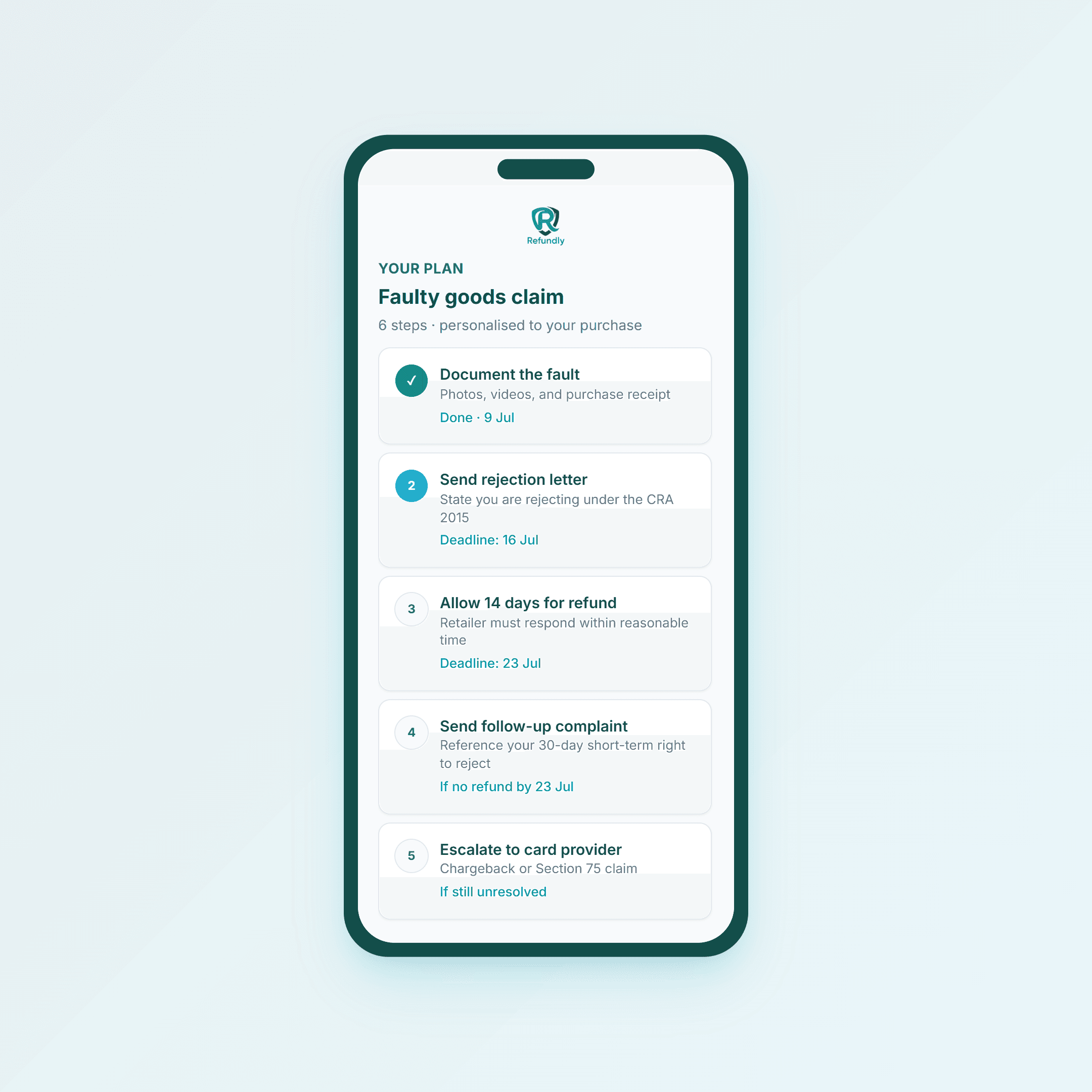 A clear plan with deadlines is harder for companies to ignore — Refundly builds this around your claim
When you are ready to act, Refundly turns this into a personalised sequence for your issue (not a generic checklist): rights in plain English, stage-by-stage next steps, and a complaint letter filled from your details.
What Your Complaint Should Cover
A strong written complaint is a checklist, not a magic script. Include:
- Your name and contact details, plus order or receipt references
- What you bought, when, and how much you paid
- What is wrong (and that it fails quality, fitness, or description under the Act)
- The remedy you want (refund / repair / replacement)
- A clear deadline for their response
- That you may escalate if they do not resolve it
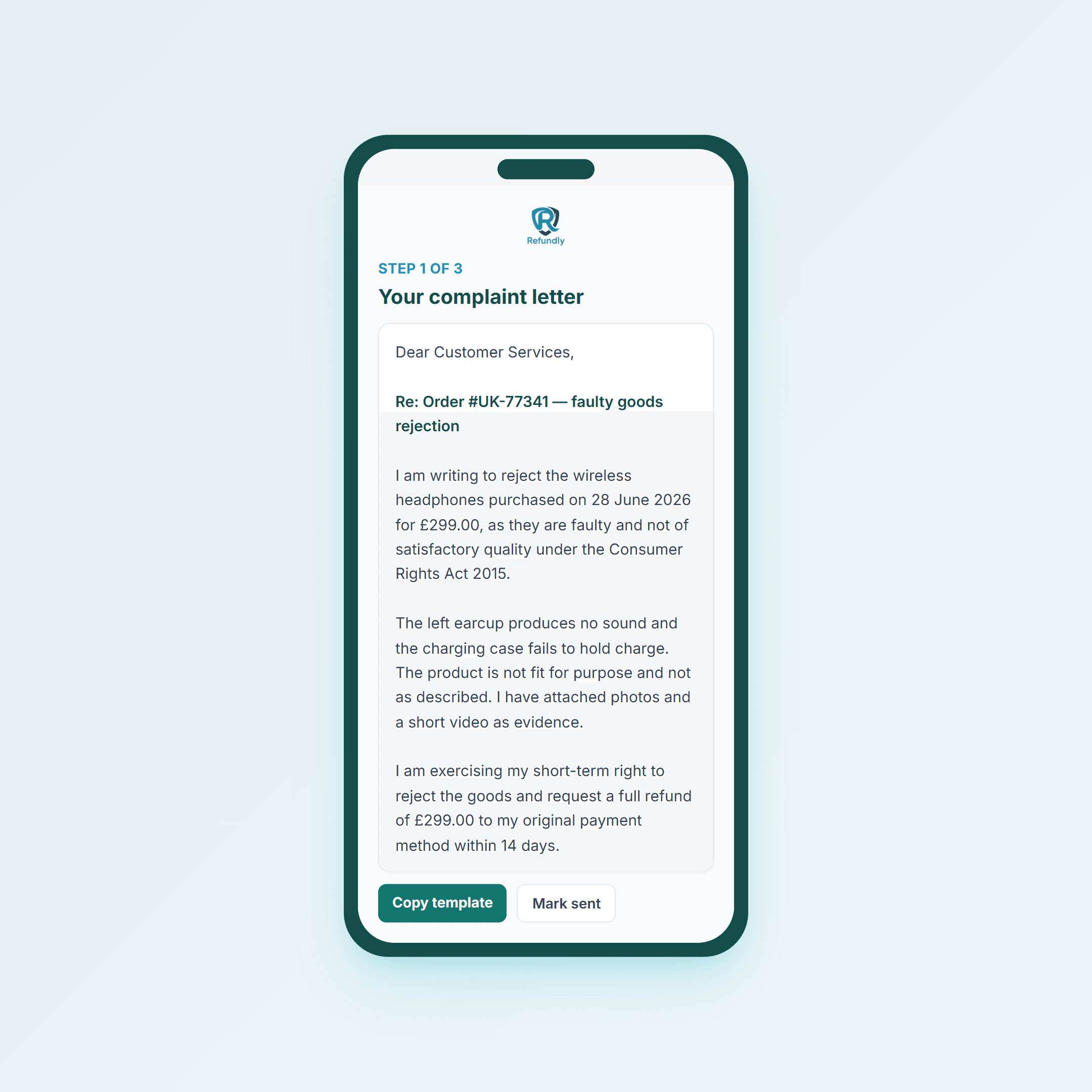 Refundly generates a tailored letter from your claim details so you are not starting from a blank page
Avoid long phone-only complaints with no follow-up in writing. If it is not written down, it is harder to prove later.
If the Retailer Refuses
A “no” is not always final. Depending on your case, people often look at:
- Chargeback (card payments) — time limits and bank rules apply
- Section 75 (credit card) — for many purchases between £100 and £30,000 where the trader and card issuer can both be in play
- ADR / ombudsman-style schemes — if the retailer is a member
- Court claim — usually a last resort for unresolved disputes
Which path fits your payment method, amount, and evidence is where free overviews stop being enough. Refundly’s plan is built to point you at the next sensible stage for the claim you logged — without you having to assemble every route yourself.
Using Refundly for a Faulty Goods Claim
If you want help running the claim rather than only reading about your rights:
- Choose the faulty / damaged goods path in the app
- Get plain-English rights for your situation
- Follow a personalised plan with reminders
- Use a complaint letter built from your details
- Track responses and export if you need to escalate
Browse rights guidance is free; Premium unlocks the full claim toolkit on web and Android with the same account.
Final Tip
Act within the 30-day window if you want the strongest shot at a full refund without accepting a repair first. Complain in writing early, keep your evidence, and do not assume a voucher is all you can get.
General information for UK consumers only — not legal advice. For official wording see the Consumer Rights Act 2015 and Citizens Advice.
Common questions
Short answers to common questions on this topic.
- Can I get a full refund for faulty goods within 30 days?
- Usually yes. Under the Consumer Rights Act 2015, if goods are faulty you can often reject them within 30 days of purchase or delivery and claim a full refund. You normally need to tell the retailer clearly and stop using the item (except reasonable testing).
- What if it is more than 30 days since I bought the item?
- You can still have rights. After 30 days the retailer may offer a repair or replacement first. If that fails, or is not possible in a reasonable time, you can still pursue a refund or a price reduction. Within the first six months, the fault is generally assumed to have been there at purchase unless the retailer can prove otherwise.
- Do I have to accept a repair or a voucher?
- Not always. Within the short-term right to reject (usually 30 days), you can often insist on a refund rather than a repair. Vouchers or store credit are not a legal substitute for a refund if you are entitled to one — unless you choose to accept them.
- Can I get a refund if I simply changed my mind?
- Not under the Consumer Rights Act alone. Changed-mind returns depend on the retailer’s policy or, for many distance sales, the separate cooling-off rules. Faulty goods are different: those rights come from the quality of the item, not from a change of heart.
- What if the retailer refuses or ignores me?
- A refusal is not always the end of the road. Depending how you paid and the value of the purchase, options can include a card chargeback, a Section 75 claim (credit card, qualifying amounts), ADR if the trader is in a scheme, or a court claim. The right next step depends on your payment method, evidence, and timeline — Refundly helps map that for your situation.